
The Self Custody Doctrine

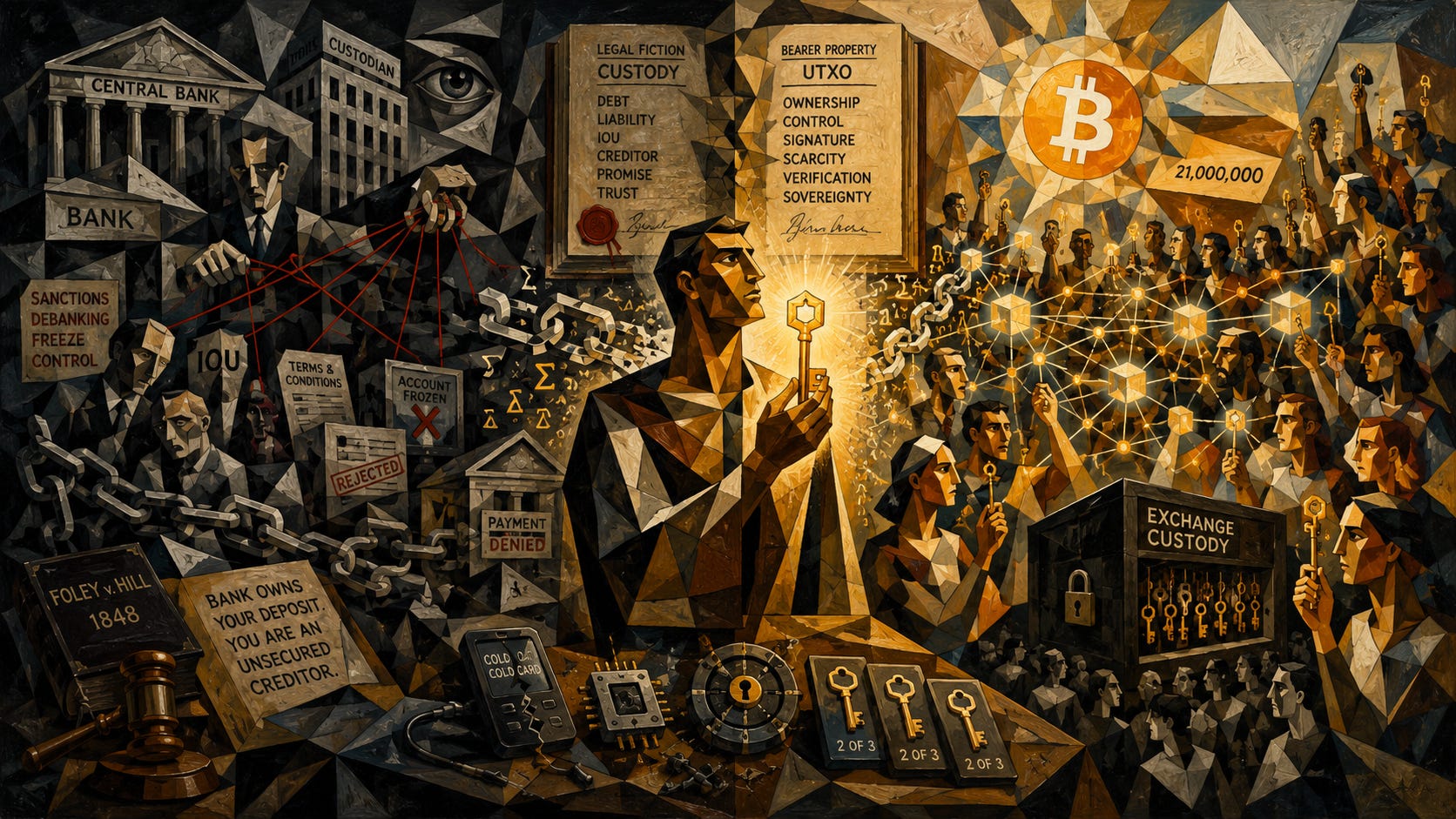
One of the major uses of fiat money by the powers that be who issue it, is its use as a system of control. Financial censorship, whether in the form of sanctions for “rogue nation states” or debanking for individuals, is a weapon meant to bend the will of the individual or institution being targeted to fall in line with that of the fiat overlords. As the saying goes, he who has the gold makes the rules. This is a definite deviation from money’s major use as a medium of exchange. In other words, fiat money is political money, as its use always comes with political strings attached.
Bitcoin destroyed this diabolical inherent flaw of fiat money, by removing trusted third parties from the equation. A very simple but profound revolutionary idea that ensured that you wouldn’t need to bow to any bankster, payment processor or fiat financial services firm. The Bitcoin white paper’s opening sentence defines the problem accurately, “Commerce on the Internet has come to rely almost exclusively on financial institutions serving as trusted third parties.” That single sentence contains the whole disease. Trust itself as a structural dependency is the vulnerability.
The necessity of trust creates systemic fragility, as intermediaries are required to mediate disputes, reverse disfavoured or fraudulent transactions, and impose fees, which inherently limits the minimum practical transaction size and freezes financial autonomy. Satoshi understood that broken trust was at the heart of counterparty risk.
The white paper’s proposed fix was narrow and precise, “an electronic payment system based on cryptographic proof instead of trust.” The paper also goes on to define the concept of an electronic coin as a chain of digital signatures, thus to own a bitcoin is to control the private key that can initiate the next signature in that chain.
If you do not hold your private keys, you do not hold the coin. You hold a claim, an IOU from the custodian keeping your Bitcoin. Custodial relationships are, by definition, a regression to the trusted third-party model Nakamoto sought to obsolete. In short, a Bitcoin balance you do not hold the keys to is actually trust-based money in another form that is subject to the political whims of the custodian.
Any system that requires trust is a system that can fail at the point of trust. Censor the intermediary, and you censor the user. The blockchain is a trust-minimization engine, but what most often miss is that it removes the need for a trusted third party in validation, not in custody. That boundary, between protocol-level decentralization and individual-level custody, is where the battle for Bitcoin’s soul is currently being fought.
Keys Are the Protocol Not an Accessory to It
While I agree that it’s important to create user friendly and beautiful products, this logic has unfortunately taken a twisted turn where Bitcoin custody is concerned as It has now become fashionable to treat private-key ownership as an implementation detail; something exchanges and custodians can abstract away for convenience, the way a bank abstracts away the mechanics of a wire transfer. This is a category error because in Bitcoin, the private key is not a password that grants access to your money sitting somewhere else. The key is the money, in every sense that matters cryptographically. Ownership on a UTXO ledger is not a database entry that says “Alice: 1 BTC.” It is the mathematical fact that whoever can produce a valid signature for a given output can spend it. Possession and control are not merely related concepts here, they are identical.
Possession is the direct, physical, unmediated relationship between a person and a thing, in other words; you hold it, you can act on it, no one stands between you and it. Control, in the legal sense that governs a bank account, is something much thinner, and it’s a right to demand an action from someone else who actually holds the thing. These sound similar in ordinary speech but they are not similar in law, and the gap between them is precisely where the risk in “your” bank balance quietly lives.
The case that settled this question for modern banking is nearly two centuries old. In Foley v Hill (1848), England’s House of Lords ruled that a bank does not hold a deposit in trust for its customer, it owns it outright. The moment money is paid in, Lord Cottenham wrote, it “ceases altogether to be the money of the principal; it is then the money of the banker,” who merely owes a debt back on demand. The depositor becomes, in the law’s own language, an unsecured creditor. Your bank balance is not an asset you possess; it is a promise you are owed, and this promise is only as good as the balance sheet backing it.
A UTXO on the other hand, collapses this two-century-old legal architecture. There is no chose in action, no creditor’s claim, no institution standing between the ledger entry and you, because there is no institution recorded on the ledger at all. Only a locking script that names a condition for spending, and a private key that satisfies it. When you hold that key, you are not owed the coin nor do you do have a claim to the coin, redeemable at someone else’s discretion, contingent on someone else’s solvency. You are, in the only sense the network recognizes, the person who can move it.
This is why the mantra “not your keys, not your coins” is not a slogan for hobbyists but a restatement of the protocol’s own logic. There is no version of Bitcoin self-custody in which you are merely a well-placed creditor. That is the whole point, and is another reason why “not your keys, not your coins”, is Foley v Hill, inverted by design.
When you deposit bitcoin on an exchange, the blockchain still says the exchange owns that UTXO. You are handed, in return, an IOU, a liability on someone else’s balance sheet, denominated in a bearer asset that was specifically engineered so that IOUs would be unnecessary. Thus voluntarily re-importing the exact counterparty risk the system was built to eliminate.
Bitcoin Sovereignty
Good money allows individuals to save the fruits of their labour without having that value arbitrarily diluted or confiscated by someone else. That said, monetary sovereignty is incomplete if ownership ultimately depends upon permission. This is where the monetary argument surrounding Bitcoin becomes inseparable from the custody argument
Bitcoin’s fixed issuance schedule and its twenty-one million supply cap, diminishing block subsidies, restores “hard money” properties in digital form. We must also acknowledge the load-bearing assumption underneath that entire argument, which is that the hardness of supply only protects you if you hold the asset whose supply is hard. A custodian sitting between you and your coins can, and historically does, rehypothecate, freeze, or simply lose what you gave them, regardless of how immutable the underlying issuance schedule is.
The soundness of Bitcoin’s monetary policy is a property of the protocol. It becomes a property of your savings only at the moment you hold your own keys. Self-custody is the hinge on which “hard money” theory converts from an abstract claim about a network into a concrete claim about your life.
Self-custody is also the ultimate defense against regulatory capture. It ensures that the base layer of the Bitcoin protocol remains untouched by the political whims of the day. When millions of individuals hold their own keys, they constitute a decentralized, ungovernable plurality. Self-custody transforms each user from being a passive spectator into an active, sovereign participant in the network.
The Coldcard Hack: A Real Failure, Not a Refutation
While self custody is preferable that doesn’t make it risk free. The Cold Card exploit earlier this month resulted in at least 1 816 BTC, worth over $100 million, being drained from more than 5,200 addresses, exploiting a firmware flaw first introduced in a March 2021 code change.
Instead of drawing randomness from Coldcard’s dedicated hardware chip, affected firmware generated seed phrases using a weaker, predictable software substitute, and had done so for over five years before the flaw was caught. It is a serious failure, and it is fair to call it the worst blow self-custody has taken.
The Coldcard hack did not break Bitcoin but exposed a flaw in a specific implementation, prompting users to adopt multisignature (multisig) setups, diversify their hardware vendors, and improve their operational security. In other words, this was not a failure of Bitcoin’s protocol, cryptography or its consensus rules, as the network performed exactly as designed. It was a supply-chain and engineering failure in one manufacturer’s key-generation process, a single bad commit that undermined the randomness a private key is built from. That is a devastating bug, but it is a bug in a tool, not a flaw in the underlying idea.
In a decentralized system, security is achieved through redundancy and diversity, not through monoculture. The cold card hack is a painful but necessary evolutionary pressure that forces the ecosystem to mature, hardening the individual against future threats. It is the price of self-sovereignty, a far lesser burden than the guaranteed erosion of wealth and freedom inherent in custodial dependency.
The lesson is not “custodying your own keys badly is safer than trusting a third party”, it never was. The lesson is that self-custody is a discipline with real engineering requirements, rather than blind faith in any single vendor’s black box. Bringing us back to the trust component once again. Reinventing trust in “Bitcoin vendors” doesn’t make your keys any safer or better protected in the absence of verification of the vendor’s product.
It’s also worth noting that from a design and user experience perspective this introduces additional complexities for the average user who merely wants to safely use Bitcoin as money with as little friction as possible. The million dollar question becomes, how should self custody be made less complex, more intuitive, more elegant without compromising the security of the user’s Bitcoin? Because let’s face it, the way self custody is done today leaves a lot to be desired, especially if the ultimate goal is for billions of people to adopt Bitcoin as money, with the majority of them holding their funds in self custody. A question I will attempt to answer in a future article, but suffice to say a lot of Bitcoin products (particularly those for self custody) have a user experience that leaves the average user feeling like they’re walking around in a minefield, as one mistake can potentially wipe out their entire stash.
The suitcoiners are undoubtedly going to use the Coldcard exploit as a weapon against self custody and have somewhat mastered how to build beautiful user interfaces that are backed by the institution’s reputation. They will likely position Bitcoin ETFs and their custodian solutions as the best way to keep your Bitcoin safe. As we saw during the plandemic, “safety” is a very powerful convincing mechanism that’ll result in myopic suicidal behaviour if there are short term benefits to be gained. In this case, it’s the illusion of safety.
Ultimately, the question of custody is a question of sovereignty. Bitcoin is an opt-out from a system where your money is a liability of a central bank, managed by commercial banks, and subject to the arbitrary freeze of a payment processor. To opt out of that casino inspired, legacy system while leaving your assets in the custody of a third party custodian is to exchange one master for another. A Bitcoin network containing thousands of independent nodes does little to protect someone whose entire balance sits behind one password at one centralized company.
The network may be decentralized but the user’s financial life is not.
The Goal Is Not to Trust Nothing
The phrase “trustless” has caused endless confusion. Bitcoin does not create a world without trust. It creates a world where fewer things require trust. The system replaces many interpersonal trust relationships with verification, cryptography and economic incentives.
That is why the Bitcoin ethos is better understood as trust minimization rather than trust elimination. This is also why self-custody should mature beyond the simplistic idea that one person with one hardware device represents the ultimate form of sovereignty.
The deeper objective is resilience. The important question is not:
“Do I use a hardware wallet?“
The important question is:
“What assumptions must remain true for me to retain control of my wealth?”
Every assumption is a potential point of failure. Good custody architecture attempts to minimize those assumptions.
The Final Principle
Freedom has always carried responsibility and Bitcoin simply makes the trade-off explicit. The revolutionary proposition was never merely that there would be 21 million Bitcoin.
It was that an individual could hold value without requiring another human institution to stand between them and their property. The closer Bitcoin gets to that original proposition, the more important self-custody becomes.
Self-custody is where the abstract promise of Bitcoin becomes concrete. It is the difference between believing that Bitcoin is decentralized and actually participating in that decentralization. It is also the difference between owning an account and owning a bearer asset with no counterparty risk.
While self custody isn’t risk free and isn’t perfect, it truly matters if your goal is to be sovereign.