
The Tokenized Stability Trojan Horse

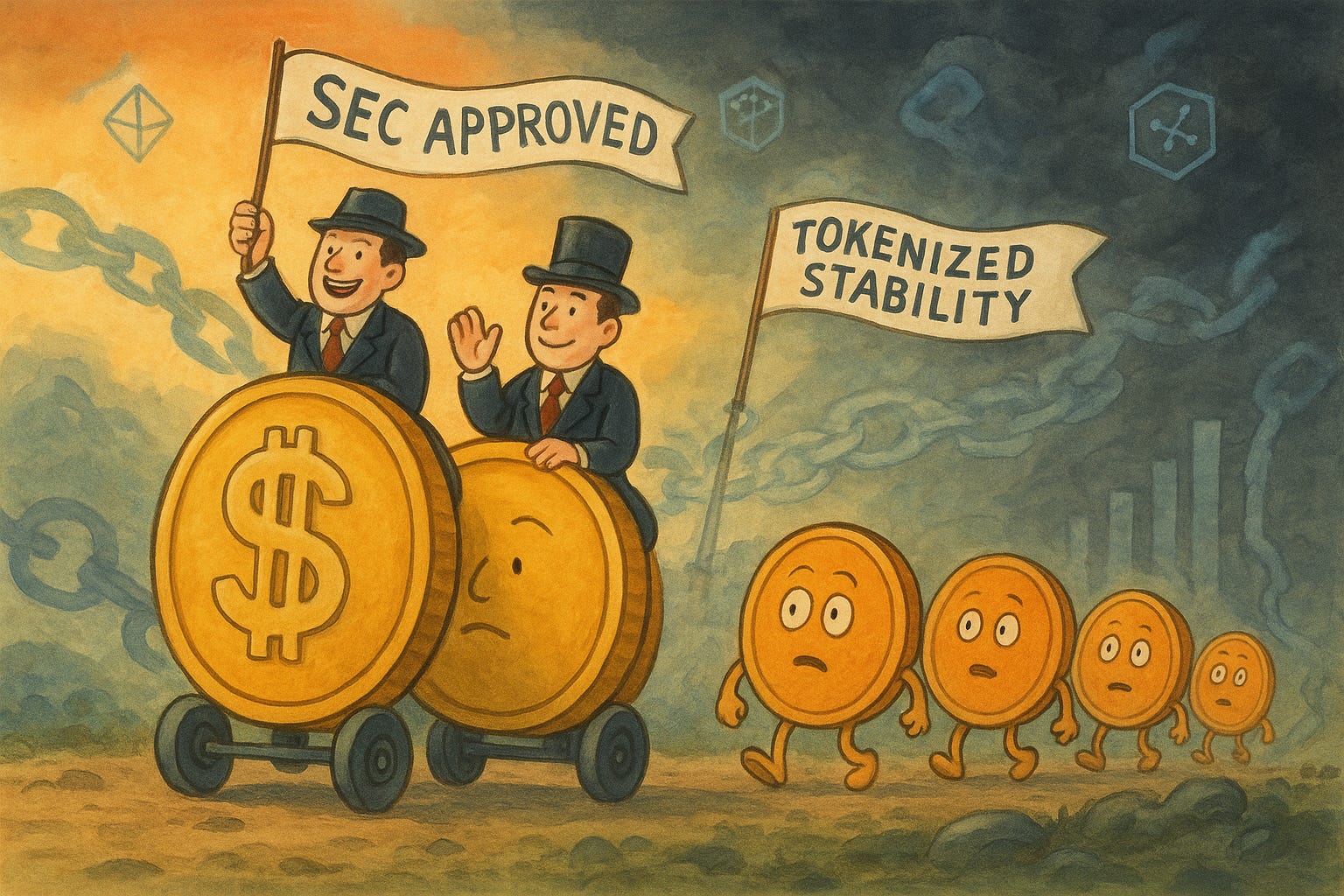
Many expected the attack on Bitcoin to arrive with sirens blaring and governments kicking down doors. Bitcoiners braced for China-style bans, shock-and-awe prohibition, the dramatic showdown we’d been warned about for a decade. They were watching the wrong door. That was the decoy.
While everyone fixated on the boogey-man of outright prohibition, the real attack was already inside the gates, dressed in Armani suits and bearing gifts of “legitimacy.” While we scanned the horizon for banhammers, Wall Street was quietly building the Trojan Horse. They didn’t need to destroy Bitcoin. They just needed to domesticate it.
The Trap of Institutional Adoption
Institutional adoption, though widely celebrated for number-go-up (NgU), wasn’t the victory lap many imagined. It was the trap. Not every player had malicious intent, but the net effect? Bitcoin got absorbed into the legacy rails it was built to replace. ETFs, custody solutions, regulatory capture, each innovation that made Bitcoin “investable” simultaneously castrated its revolutionary purpose.
Bitcoin’s role as a peer-to-peer medium of exchange was side-lined, replaced with a Wall Street-approved narrative designed to reduce it to a shiny, decentralized “stonk,” sanitized by the same system it threatened to obsolete. This is how the lexicon of “digital assets” crept in; language engineered to strip away Bitcoin’s insurgent DNA and fold it neatly into TradFi’s portfolio allocation matrix.
Enter the Next Battalion
The Trojan Horse didn’t stop with ETFs or the leveraged corporate treasuries of public companies like Strategy, allegedly under attack by the banking cartel with JP Morgan leading the charge. The next battalion has already rolled onto the battlefield, weaponizing “crypto” by tethering it to TradFi. These new instruments of financial subjugation are called Tokenized Money Market Funds (TMMFs).
TMMFs are the banking cartel’s latest hallucination to hoodwink the masses: digital assets on the blockchain that represent real-world assets. According to the Bank of International Settlements (BIS), TMMFs “seek to provide an alternative, yield-bearing source of on-chain collateral, mimicking features of government bonds—the backbone of collateralized transactions in traditional finance.”
Translation: Treasury bills in a hoodie.
The Growth Story
The numbers are striking. From just $770 million at the end of 2023, TMMFs exploded to nearly $9 billion by October 2025, more than a tenfold increase in less than two years.
Major traditional finance players have entered the space:
BlackRock launched its BUIDL fund (the largest TMMF)
Franklin Templeton offers tokenized products
Crypto-native companies like Circle and Ondo Finance have also launched funds
While this narrative intoxicates casual observers, make no mistake: TMMFs are neither decentralized nor a step forward. They are U.S. government debt wrapped in a shiny ERC-3643 smart contract and sold back to the crypto ecosystem as innovation. The sleight of hand? The public gets familiar financial products that exhibit Bitcoin-like efficiency, with the banking cartel holding the reins in the background.
The BIS gushes about their “growth” and “efficiency,” but behind the jargon lies a simple truth: TMMFs are fiat rails invading the blockchain. Fiat 2.0.
Hyper-Centralization on Chain
Every TMMF token is built on:
Strict KYC
Regulated allow-lists
Identity-bound wallets
Transfer restrictions
Freeze and seizure functions
Central custodians
Jurisdictional control
Off-chain oracles
Legal enforcement baked into code
This isn’t decentralization. It’s hyper-centralization on-chain, with Wall Street controlling every aspect of transactions within their regulated cages. The suits have figured out how to use decentralized tools while gutting their purpose. They’re building “crypto” that requires their permission, depends on their infrastructure, and preserves their power.
The Philosophical Poison
Bitcoin solved a problem no one thought was solvable: creating scarce digital property that requires zero trust in institutions. You don’t need BlackRock’s permission. You don’t need a government’s blessing. You don’t need to prove who you are.
TMMFs resurrect every problem Bitcoin buried:
Counterparty risk? You’re trusting fund managers, custodians, transfer agents, oracle providers, and the U.S. Treasury.
Censorship? Allow-lists can be “regularly updated”—bureaucrat-speak for “we can delete you.”
Centralization? Four wallets hold 90% of the largest funds.
Permissioned access? KYC/AML checks required. Some funds only accept “qualified purchasers” with millions.
The BIS admits the entire operation is a hybrid sham:
“In the absence of native tokenized assets... a range of TMMF activities are still performed off-chain.”
Translation: the blockchain is decorative. The control remains centralized.
Why This Matters
“But Bitcoin operates independently,” some will argue. “What does it matter if TradFi wants to tokenize Treasuries?”
It matters because the war has always been ideological, not just technological.
TMMFs give regulators exactly what they’ve always wanted: a category called “responsible crypto” that requires permission, enables surveillance, and preserves institutional control. Bitcoin becomes the outlaw cousin; volatile, suspicious, only for criminals and shadowy super coders.
The narrative shift is already underway. Why would anyone need permissionless Bitcoin when BlackRock offers stable, yield-bearing, SEC-regulated tokens? Why hold an asset that doesn’t pay interest when you can earn money market rates on-chain? Well, because freedom isn’t supposed to be efficient. That’s the entire point.
The Genesis Reminder
Satoshi didn’t create Bitcoin so BlackRock could issue more efficient IOUs. The whitepaper doesn’t say “A Peer-to-Peer Electronic Cash System (With KYC).” The genesis block doesn’t reference Treasury bills, it references bank bailouts.
TMMFs represent the financial establishment’s counteroffer: “Yes, blockchain technology is useful, but only when we control it, when we know who’s using it, and when we can turn it off if authorities demand.”
When institutions deploy digital assets to maintain control rather than distribute it, that’s not adoption, it’s capture. When “going mainstream” means abandoning the properties that made Bitcoin valuable, that’s not success, it’s surrender.
The Choice
The question is whether the Bitcoin community will remember why that matters, or whether it will trade revolution for yield, sovereignty for stability, and freedom for the comfort of institutional approval.
Choose hard money or choose hard coping. There is no third option